
Percentages
Help your child see a percent as “how many out of 100” before moving into calculations, benchmarks, and converting between fractions, decimals, and percents.
Core idea
A percent is a share of 100
Picture one whole split into 100 equal squares. Shade some squares, count them, and the count itself is the percent. Every percent question your child meets reuses that one picture.
Percent means out of 100
Every percent is a fraction whose whole was split into 100 equal pieces. That single picture explains 25%, 50%, and every other percent your child meets.
Two questions, one model
Percentages answer two questions: what part of the whole is this, and what is this percent of the whole. The same 100-square grid explains both.
Built on fraction sense
Percents are fractions with a friendly denominator. A child who can picture one half can picture 50%, so fractions keep doing the heavy lifting.
Start here
Percentage topics
We are growing this topic one strong page at a time, the same way we built the fractions library.
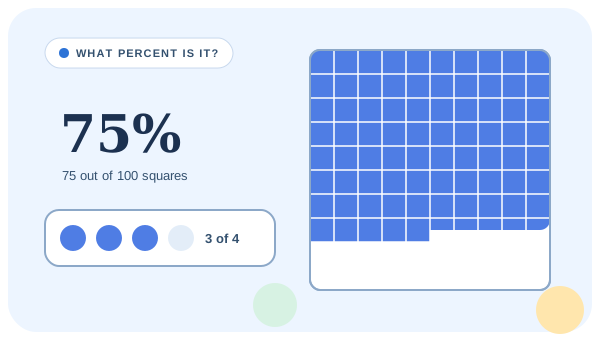
Percentage Calculations
Find what percent one number is of another, take a percent of a number, and see both ideas with a visual percent grid.
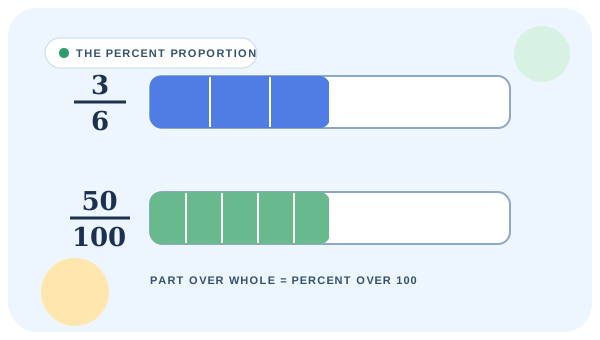
Parts, Wholes, and Percentages
Solve the percent proportion — part over whole equals percent over 100 — and find the missing part, whole, or percent with a step-by-step explorer.
Why percentages come after fractions
A percent is a fraction wearing a friendlier outfit.
Percents arrive in everyday life early — test scores, battery icons, discounts — but they only make sense once a child can name the whole and reason about equal parts. That is exactly the skill the fractions topic builds, so percentages are the natural next step on LumaMath.
The 100-square model keeps the meaning visible. When your child shades 25 squares and says “25 out of 100,” they are also seeing 25/100, one quarter, and 0.25 as the same amount in three notations. Keeping those forms connected is what makes later percent calculations feel like reasoning instead of rule-collecting.
Meaning first, shortcuts second
The 10% and 1% shortcuts only feel safe once a child can explain what a percent measures. Keep the model nearby while practicing shortcuts.
One grid explains both directions
Finding a percent of a whole and finding what percent one number is of another use the same picture. Reusing it keeps the two skills connected instead of separate rules.
Everyday numbers make good practice
Scores, prices, and battery levels give real wholes and parts. Children reason better about percents when the whole is something they can picture.
Learning path
Meaning, benchmarks, then calculations.
- 1. Meaning: see a percent as shaded squares out of 100, connected to known fractions.
- 2. Benchmarks: use 50%, 25%, and 10% as friendly anchors for estimating.
- 3. Converting: move between percents, fractions, and decimals without losing the amount.
- 4. Calculations: find the percent one number is of another, and take a percent of a number.
Tips for Parents
Anchor every percent to a whole your child can picture.
Percents go wrong when the whole goes unnamed. Keep asking what the 100 pieces refer to, and let everyday numbers do the teaching.
- Start with the 100-square picture: ask your child to shade 25 squares and say “25 out of 100 — twenty-five percent.”
- Connect percents to fractions your child already knows: one half is 50%, one quarter is 25%, three quarters is 75%.
- Say what the whole is before naming a percent. 50% of a small snack and 50% of a large pizza are different amounts.
- Use money and everyday scores: a test score of 18 out of 20, a 10% discount, or a battery at 75% all reuse the same model.
Common questions