
Worked example
Convert 0.5 to a fraction
0.5 = 5/10 = 1/2
One digit after the decimal means tenths. Write 5 over 10, then divide both numbers by 5. The fraction 1/2 is easier to recognize, but it still represents exactly five tenths.
Decimal conversion
Change a terminating decimal into a fraction by using place value first, then simplifying the result. The amount stays the same; only the way you write it changes. This method works for short homework answers such as .5 and for longer decimals such as 0.625 or 2.75, because every terminating decimal names a specific number of tenths, hundredths, thousandths, or smaller equal parts.
Explore all fraction conversionsQuick answer
Interactive calculator
Enter a terminating decimal to see the original place-value fraction, the simplest form, and a visual model of the same amount.
Result
Place value method
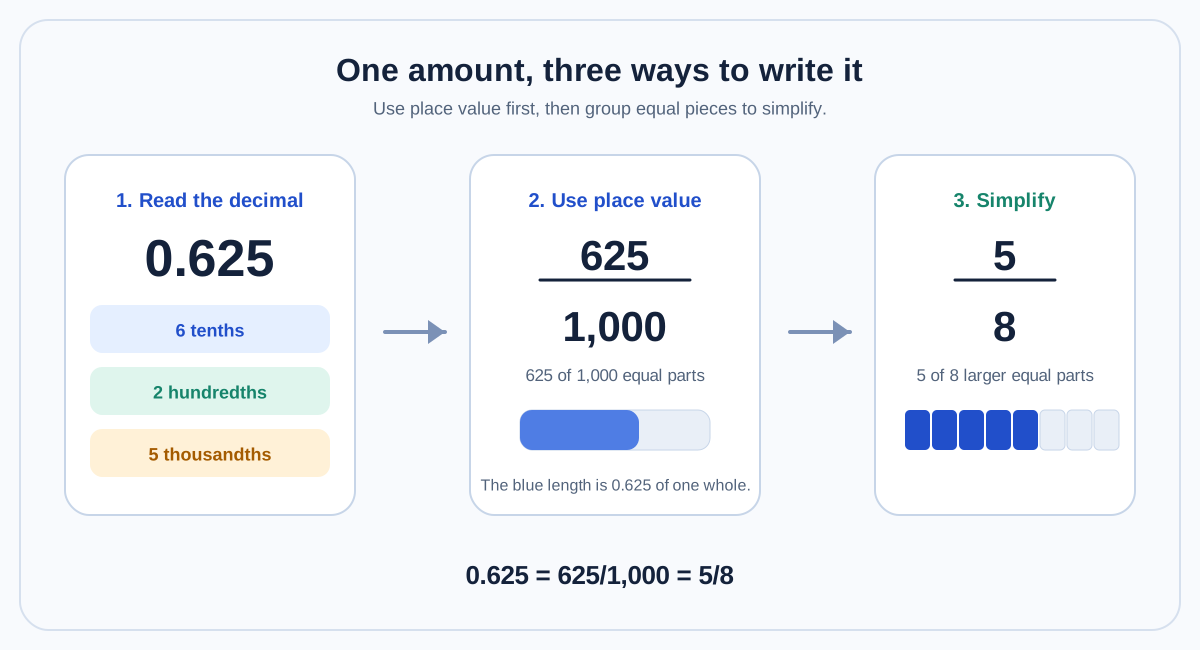
The denominator comes from the decimal place, not from guessing. In 0.625, there are three digits after the decimal point, so the number means 625 thousandths. Thousandths are pieces with a denominator of 1,000, which is why the first fraction is 625/1,000.
0.625 = 625/1,000
= 625 ÷ 125 / 1,000 ÷ 125
= 5/8
This is the decimal-to-fraction equation in its most useful form: decimal, original place-value fraction, then simplest fraction. If the decimal has one digit, use 10; if it has two digits, use 100; if it has three digits, use 1,000. The same pattern continues for any terminating decimal supported by the calculator.
Worked example
0.5 = 5/10 = 1/2
One digit after the decimal means tenths. Write 5 over 10, then divide both numbers by 5. The fraction 1/2 is easier to recognize, but it still represents exactly five tenths.
Worked example
0.04 = 4/100 = 1/25
Two digits after the decimal means hundredths, even when the first digit is zero. The zero tells you there are no tenths and four hundredths, so 0.04 cannot be written as 4/10.
Worked example
0.625 = 625/1,000 = 5/8
Three digits after the decimal means thousandths. Dividing 625 and 1,000 by 125 gives the simplest form. Both fractions describe the same shaded amount; only the size of one equal part changes.
Worked example
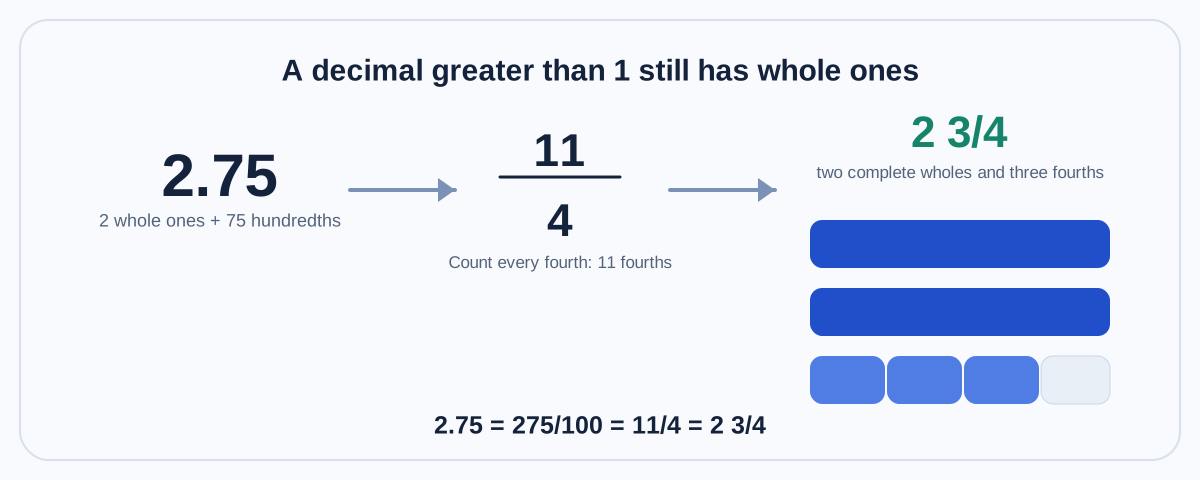
2.75 = 275/100 = 11/4 = 2 3/4
Move the decimal two places by writing 275 over 100. The simplified improper fraction can also be written as a mixed number, which makes the two complete wholes visible again.
A decimal less than 1 starts with zero wholes, so focus on the digits after the decimal point. The first place is tenths, the second is hundredths, and the third is thousandths. That is why 0.5 is five tenths, or 5/10, before simplifying to 1/2.
Zeros matter because they hold a place. In 0.04, the zero says there are no tenths and four hundredths. Write 4/100, then simplify to 1/25. Reading the decimal aloud—“four hundredths”—is a quick way to choose the correct denominator before you start calculating.
Use the same denominator rule for a decimal greater than 1. Since 2.75 has two digits after the decimal point, write 275/100. The whole number does not disappear; it is included in the numerator because 2.75 means 275 hundredths.
Simplify 275/100 to 11/4, then use division to write the same amount as 2 3/4 when a mixed number is easier to read. An improper fraction and a mixed number are two names for the same quantity, so either form can be correct when the question does not specify one.
Simplifying does not change the decimal’s value. Find the greatest common factor shared by the numerator and denominator, then divide both by that same number. For 625/1,000, both numbers divide by 125, leaving 5/8. A good first check is whether both numbers are even, end in 0 or 5, or share another familiar factor.
Never divide only one side of a fraction because that would change the amount. Dividing both numbers by the same nonzero number is like grouping the same shaded pieces into larger equal bundles: the name changes, but the portion of the whole does not.
After you simplify, divide the numerator by the denominator to see whether you get the original decimal. For example, 5 ÷ 8 = 0.625, so 5/8 is a correct simplified form of 0.625. This reverse check is especially helpful when a decimal has several places or when you are unsure whether you used 100 or 1,000 as the denominator.
Trailing zeros do not change the value. The decimals 0.5, 0.50, and 0.500 all equal one-half, even though their first place-value fractions are 5/10, 50/100, and 500/1,000. Simplifying reveals that they all describe the same amount.
This page is for terminating decimals such as 0.3, 0.625, and 2.75. They stop after a fixed number of digits, so a denominator of 10, 100, or 1,000 gives an exact starting fraction. A repeating decimal such as 0.(3) or 0.1(6) does not end, so it uses a different equation method.
Do not treat 0.3 and 0.(3) as the same number. The first is three tenths, or 3/10; the second repeats forever and equals 1/3. Keeping those two cases separate helps you choose the correct tool and explanation.
Convert a repeating decimal to a fractionKeep learning
Common questions