How to Turn a Mixed Number Into an Improper Fraction
Learn the reliable multiply-add-keep method for turning a mixed number into an improper fraction. The value does not change; you are only counting every equal fractional part in one numerator.
Rewrite the same amount in either direction and see the multiplication, addition, division, and remainder steps.
Result
Quick answer
Multiply, add, and keep the denominator
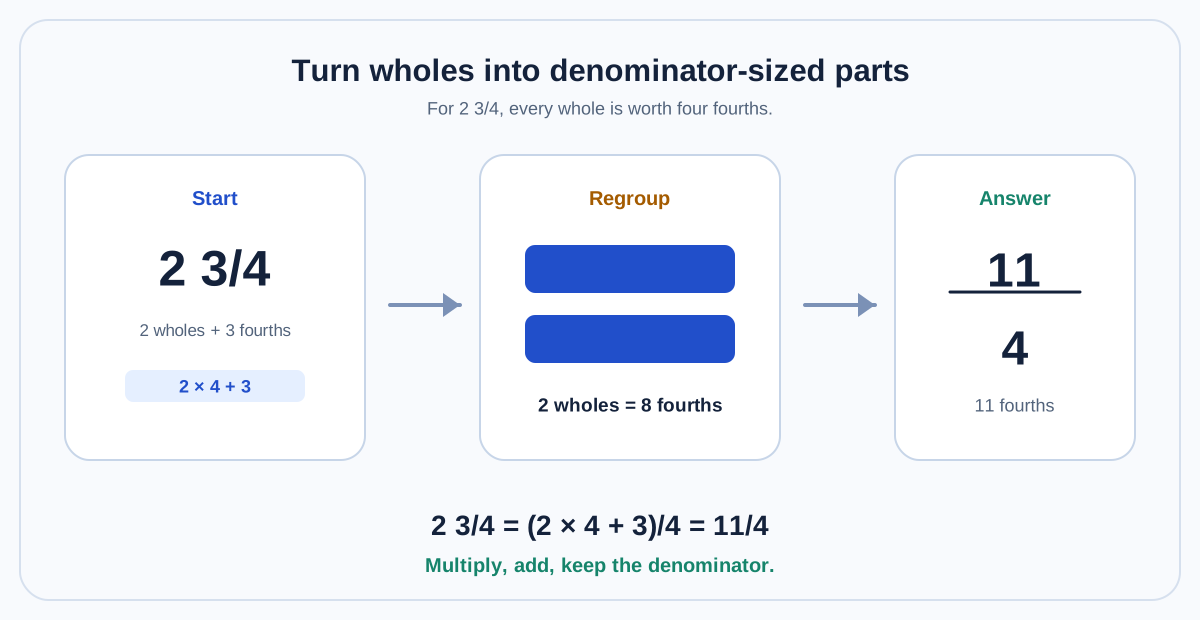
To convert 2 3/4, multiply the whole number 2 by the denominator 4, add the numerator 3, and put the result over 4: (2 × 4 + 3)/4 = 11/4. The denominator stays 4 because the answer is still measured in fourths.
1. Multiply. Whole number × denominator.
2. Add. Add the numerator to that product.
3. Keep. Use the original denominator.
What is a mixed number?
A mixed number has a whole-number part and a proper fraction part. In 2 3/4, the 2 means two complete wholes, while 3/4 means three of four equal parts of another whole. The space between them means addition: 2 3/4 is the same amount as 2 + 3/4.
An improper fraction writes that same amount as one fraction. Its numerator is greater than or equal to its denominator because it counts at least one complete group of fractional parts. Therefore 2 3/4 and 11/4 look different, but they name exactly the same quantity.
Every whole is regrouped into denominator-sized parts. Two wholes become eight fourths, and three more fourths make eleven fourths.
Why change a mixed number into an improper fraction?
A mixed number is often easiest to read because it separates complete wholes from the leftover part. An improper fraction is often easier to calculate with because every amount is written as one numerator over one denominator. Before multiplying or dividing fractions, rewrite mixed numbers first so that every factor uses the same fraction format.
For example, multiplying 2 3/4 by 2/3 is much clearer after changing 2 3/4 to 11/4. Then multiply 11/4 × 2/3, instead of trying to multiply a whole number and a fraction separately. The conversion is not an extra trick; it is a way to preserve the exact amount while making the next operation follow one consistent rule.
The multiply-add-keep formula
The formula works for every non-negative mixed number with a proper fraction part. Read it from left to right: multiply the whole number by the denominator, add the numerator, and keep the denominator below the line.
1. Read the denominator
The denominator names the equal-sized parts. In 2 3/4, the denominator 4 means every whole can be renamed as four fourths.
2. Multiply the whole number
Multiply 2 × 4 = 8. This counts how many fourths are contained in the two complete wholes.
3. Add the numerator
Add the leftover 3 fourths: 8 + 3 = 11 fourths. The numerator now counts every selected part.
4. Keep the denominator
Write 11 over 4. The answer is 11/4 because the parts are still fourths, not a new kind of part.
2 3/4
= (2 × 4 + 3)/4
= (8 + 3)/4
= 11/4
Mixed number to improper fraction examples
The denominator controls the counting. Once you know whether the parts are halves, fourths, fifths, or eighths, the same method works without changing the final denominator.
Mixed number
Calculation
Why it works
1 1/2
(1 × 2 + 1)/2 = 3/2
One whole is two halves. Add the extra half to make three halves.
2 3/4
(2 × 4 + 3)/4 = 11/4
Two wholes contain eight fourths. Three more fourths make eleven fourths.
3 2/5
(3 × 5 + 2)/5 = 17/5
Three wholes contain fifteen fifths, then add two fifths.
4 7/8
(4 × 8 + 7)/8 = 39/8
Four wholes are thirty-two eighths. With seven more, the total is thirty-nine eighths.
Why the denominator stays the same
The denominator is the unit label for the parts. If a pizza is cut into fourths, every slice is still one fourth even after you count slices from several pizzas. Turning 2 3/4 into 11/4 changes the number of slices being counted, not the size of each slice.
This is different from simplifying a fraction. Simplifying changes both numerator and denominator by the same factor because it groups equal pieces together. Mixed-number conversion does not group or resize pieces; it simply replaces complete wholes with their equivalent number of denominator-sized parts.
A quick reasonableness check
Your improper fraction should be greater than the whole number in the original mixed number. Since 2 3/4 is greater than 2 but less than 3, 11/4 must also be greater than 2 and less than 3. Dividing 11 by 4 gives 2 remainder 3, so the check agrees with the original value.
You can also compare the numerator with nearby denominator multiples. For 4 7/8, four wholes equal 32/8 and five wholes equal 40/8. The answer 39/8 belongs between them, exactly where 4 7/8 should be. This mental check catches common errors such as forgetting to multiply the whole number or changing the denominator.
Convert an improper fraction back to a mixed number
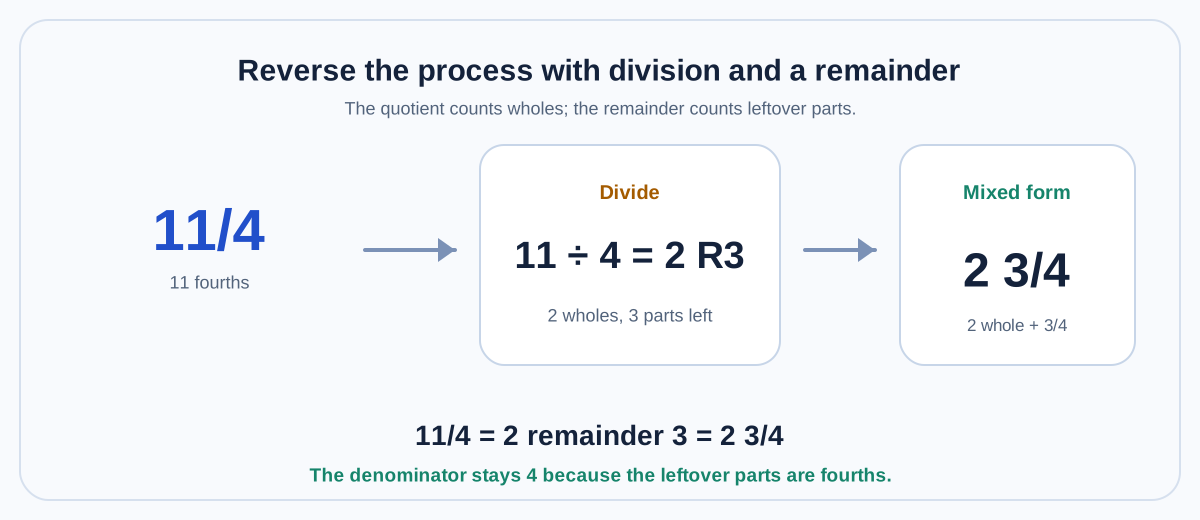
To reverse the process, divide the numerator by the denominator. The quotient is the number of complete wholes, the remainder is the leftover numerator, and the denominator stays the same. For 11/4, 11 ÷ 4 = 2 remainder 3, so the answer is 2 3/4.
Division reverses the conversion: the quotient counts complete wholes, while the remainder becomes the numerator of the leftover fraction.
Common mistakes to avoid
Adding before multiplying: 2 + 4 + 3 is not the conversion. First count the fourths in the whole numbers with 2 × 4.
Changing the denominator: do not write 11/8 or 11/3 for 2 3/4. The denominator remains 4.
Forgetting the numerator: the extra fraction part must be added after the wholes are renamed.
Calling every fraction improper: a fraction is improper only when its numerator is greater than or equal to its denominator.
Check that both forms name the same amount
Use the reverse division check: divide the new numerator by the denominator and look for the original whole number and remainder. For 39/8, 39 ÷ 8 = 4 remainder 7, which returns 4 7/8. You can also rewrite the whole number as a fraction: 2 3/4 = 8/4 + 3/4 = 11/4.
This check is especially useful before multiplying or dividing fractions. Once every value is written in one fraction form, you can apply fraction rules without accidentally operating on the whole and fractional parts separately.