A mixed number has a whole number and a fraction part. Keep the whole number, turn the fraction into a decimal by dividing its numerator by its denominator, and then add the two parts together.
Keep the whole number, convert the fractional part, and see every step before the final decimal.
Result
Quick answer
Keep the whole number, then convert the fraction
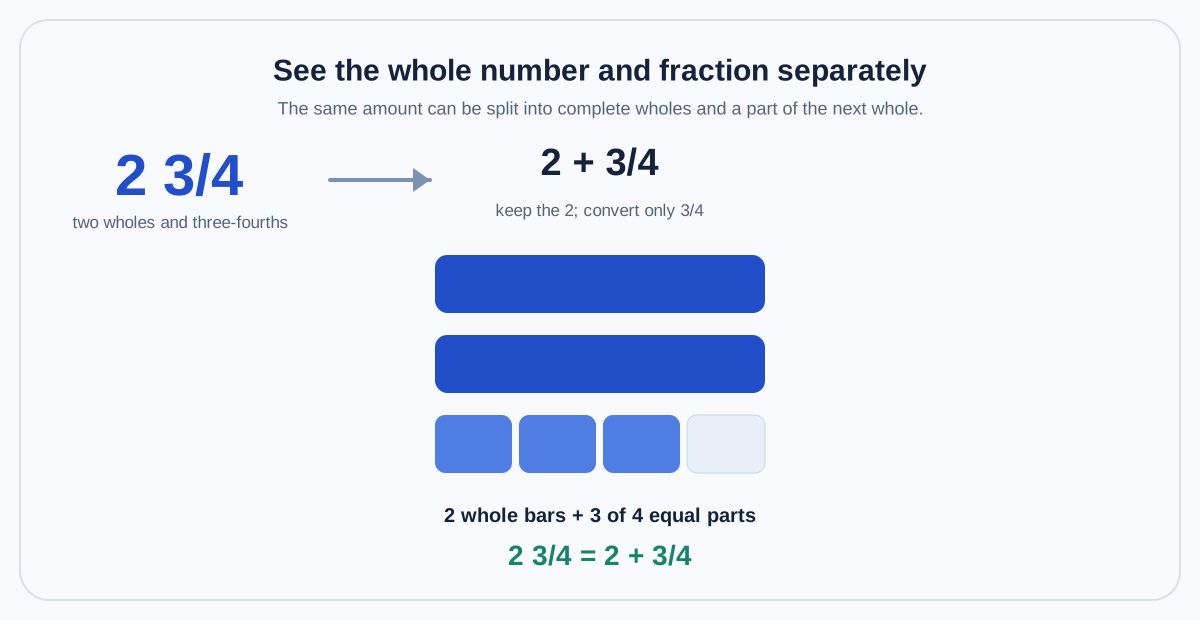
1. Keep the whole. In 2 3/4, the 2 means two complete wholes.
2. Divide the fraction. 3 ÷ 4 = 0.75.
3. Add. 2 + 0.75 = 2.75.
What is a mixed number?
A mixed number combines a whole number with a proper fraction. In 2 3/4, the 2 represents two complete wholes and 3/4 represents three of four equal parts of another whole. The space between the 2 and the fraction means “plus,” so the expression is another way to write 2 + 3/4.
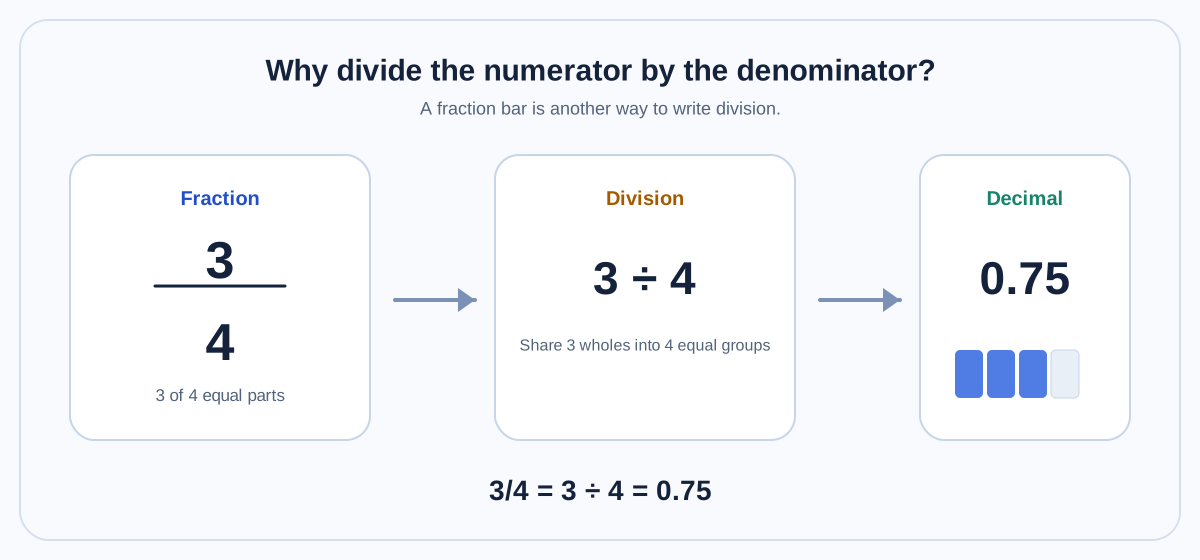
The fraction bar is not a separator between unrelated numbers; it means division inside the fractional part. The numerator tells how many parts you have, and the denominator tells how many equal parts make one whole. This meaning stays the same when you rename the fraction as a decimal.
The whole-number part stays intact. Only the three-fourths portion needs to be renamed as a decimal.
That is why the direct conversion keeps the 2 visible and changes only 3/4 into 0.75. The amount remains two and three-fourths throughout the process; only its notation changes.
Convert the fractional part by division
To turn the fractional part into a decimal, divide the numerator by the denominator. In other words, read the fraction bar as a division sign. For 3/4, divide 3 by 4. For 1/5, divide 1 by 5. For 7/8, divide 7 by 8. The quotient is the decimal name for that part of one whole.
Step 1: Identify the parts. Separate the whole number from the proper fraction.
Step 2: Divide. Calculate numerator ÷ denominator for the fraction part.
Step 3: Add. Combine the decimal fraction with the whole number.
2 3/4
= 2 + 3 ÷ 4
= 2 + 0.75
= 2.75
Notice that 3 ÷ 4 is less than 1, so its decimal must be between 0 and 1. Adding it to 2 gives a result between 2 and 3. This size check is useful: if your answer were 2.075 or 27.5, the decimal point would be in the wrong place.
A fraction, a division expression, and a decimal can describe exactly the same amount: 3/4 = 3 ÷ 4 = 0.75.
Mixed number to decimal examples
Mixed number
Keep + divide
Decimal
Why
1 1/2
1 + 1/2
1.5
One-half is 0.5, so add it to the one whole.
2 3/4
2 + 3/4
2.75
Three-fourths is 0.75, so the total is two and seventy-five hundredths.
3 1/5
3 + 1/5
3.2
One-fifth is 0.2, so keep the three wholes and add two tenths.
4 7/8
4 + 7/8
4.875
Seven-eighths is 0.875, giving a decimal just below five wholes.
Use an improper fraction as another method
You can also convert the mixed number to an improper fraction first. Multiply the whole number by the denominator, add the numerator, and keep the denominator: 2 3/4 becomes (2 × 4 + 3)/4 = 11/4. Then divide 11 by 4 to get 2.75.
Why does this work? Each whole contains four fourths, so two wholes contain 2 × 4 = 8 fourths. Add the extra 3 fourths and you have 11 fourths. Dividing 11 by 4 counts how many whole units and leftover parts are in that total.
The direct method is often easier for a first explanation because it keeps the whole number visible. The improper-fraction method is useful when the same problem will continue into multiplication, division, or another fraction operation. Both methods must give the same decimal; if they do not, recheck the multiplication step or the division.
Terminating and repeating decimal answers
A decimal terminates when the division ends, such as 3/4 = 0.75 or 1/5 = 0.2. In simplest form, these fractions have denominators made only from factors of 2 and 5, the factors that build powers of 10. You do not need to memorize that rule to calculate, but it explains why fourths, fifths, eighths, and tenths often produce familiar finite decimals.
A decimal repeats when the long-division remainder never becomes zero. For example, 1/3 = 0.333…, so 1 1/3 = 1.333…. The dots mean the 3 continues forever. Do not round a repeating answer unless the question asks for a particular number of decimal places; write the ellipsis or use a repeating-decimal notation instead.
Common mistakes to avoid
Dividing the wrong numbers: use numerator ÷ denominator, not denominator ÷ numerator. The expression 3/4 means 3 ÷ 4.
Dropping the whole number: 2 3/4 is not 0.75. Keep the 2 and add the decimal fraction.
Moving the decimal point without a reason: place value matters. Use long division or an equivalent fraction rather than guessing.
Rounding too early: keep enough digits to represent the fraction accurately, especially when the answer repeats.
What if the decimal repeats?
Some fractional parts produce a decimal that never ends. For example, 1/3 = 0.333..., so 1 1/3 = 1.333.... The calculator shows a short preview with an ellipsis instead of pretending that the decimal stops. Use the separate repeating-decimal lesson to learn how those values can be represented exactly as fractions.
Convert the decimal part back into a fraction or divide the improper fraction directly. If you converted 2 3/4 to 2.75, check that 2.75 = 275/100 = 11/4 = 2 3/4. The whole number and fractional part should return to the same amount, not merely a nearby rounded value.
You can also use a number-line estimate. Since 3/4 is three quarters of the way from 0 to 1, 2 3/4 should sit three quarters of the way from 2 to 3. The decimal 2.75 has exactly that location. A visual estimate will not replace the calculation, but it catches answers that are too small or too large.