Enter a percent and see it written over 100, converted to an integer fraction, simplified, and shown as a mixed number when needed.
Result
Quick answer
Write the percent over 100, then simplify
To turn a percent into a fraction, replace the percent sign with a denominator of 100. Then remove any decimal by multiplying the top and bottom by the same power of 10, and simplify. For example, 25% = 25/100 = 1/4.
1. Write over 100. Percent means per hundred.
2. Clear decimals. Multiply both parts equally.
3. Simplify. Divide by a common factor.
What does percent mean?
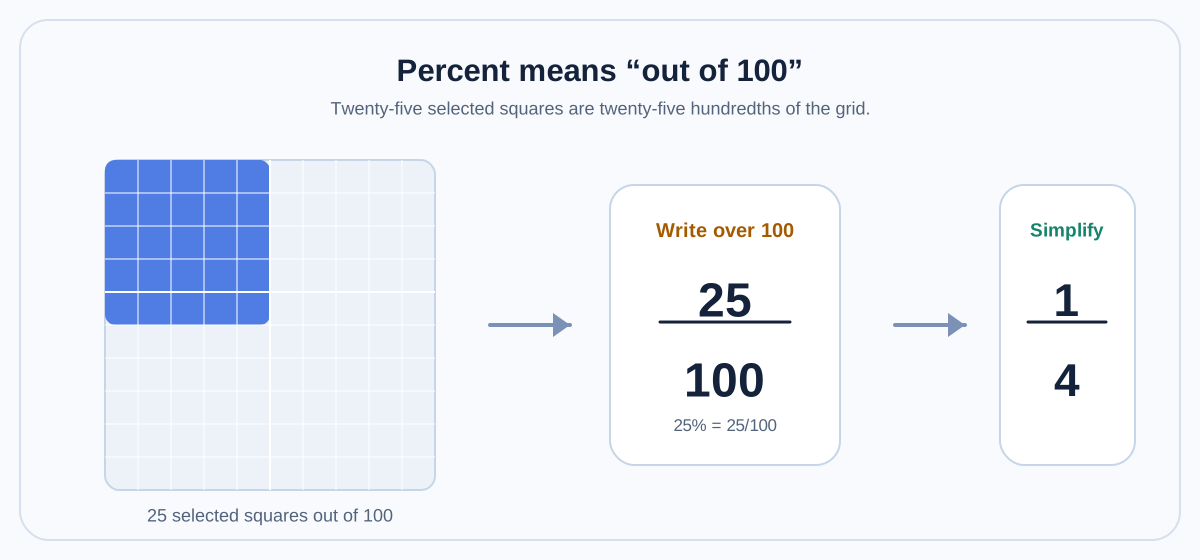
The word percent means “per hundred.” The symbol % is a compact way to say “out of 100 equal parts.” Therefore 25% means 25 out of 100, or 25/100. The fraction is not a new amount; it is the same amount written without the percent symbol.
This idea also explains familiar benchmarks. 50% is 50/100, which simplifies to 1/2. 75% is 75/100, which simplifies to 3/4. 100% is 100/100, which equals one complete whole. A percent below 100% names less than one whole, while a percent above 100% names more than one whole.
Twenty-five selected squares out of 100 are 25/100. Grouping them into four equal quarters gives the simpler fraction 1/4.
How to turn a percent into a fraction
Use the same four-step process whether the percent is a whole number or a decimal. The first denominator is always 100 because of the percent sign. Decimal places only tell you how many extra zeros are needed to make the numerator an integer.
1. Put the percent over 100
The percent sign means “per hundred,” so 25% becomes 25/100.
2. Clear a decimal if needed
For 62.5/100, multiply the numerator and denominator by 10 to get 625/1000.
3. Find a common factor
Divide the numerator and denominator by the same greatest common factor.
4. Write the simplest answer
Keep dividing both parts together until no larger common factor remains.
25%
= 25/100
= 1/4
Convert a decimal percentage
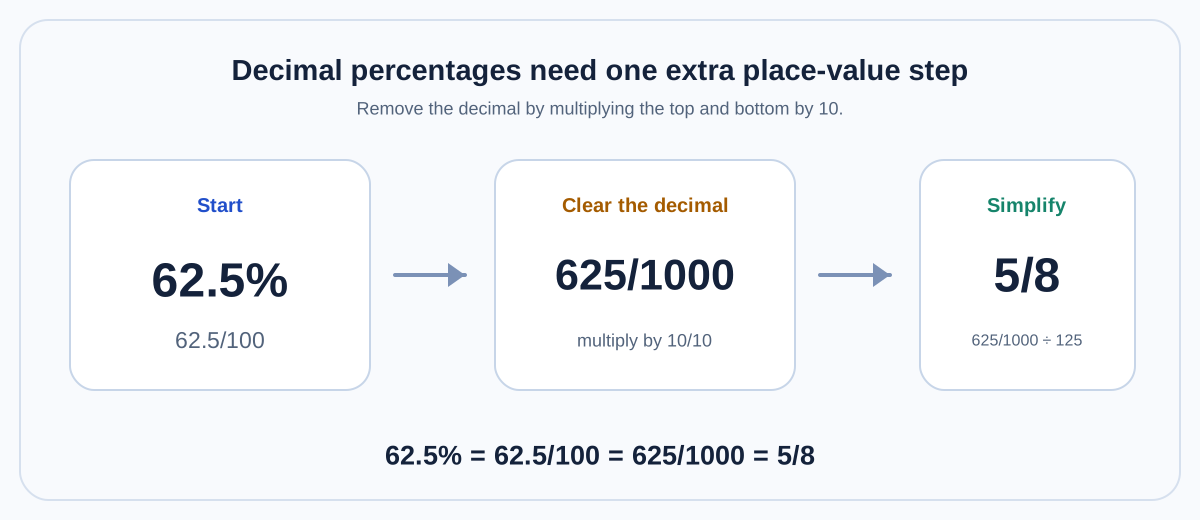
A decimal percentage has a decimal point before you write it over 100. For 62.5%, start with 62.5/100. Multiply the numerator and denominator by 10 to move the decimal one place: 625/1000. Finally, divide both by 125 to reach 5/8.
The important rule is to multiply both parts by the same number. Multiplying only the numerator would change the amount. Multiplying by 10/10 changes the notation but keeps the value exactly the same.
For a decimal percent, first clear the decimal with an equal multiplication on top and bottom, then simplify the resulting integer fraction.
Percent to fraction examples
These examples cover the most common homework and calculator questions: familiar benchmarks, decimal percentages, values above 100%, very small percentages, and a mixed percentage.
Percent
First fraction
Simplest answer
Explanation
25%
25/100
1/4
Twenty-five out of one hundred simplifies by dividing both numbers by 25.
50%
50/100
1/2
Half of the one-hundred-square grid is selected.
62.5%
625/1000
5/8
The decimal percent needs thousandths before it can be simplified.
125%
125/100
5/4 = 1 1/4
More than one whole becomes an improper fraction and then a mixed number.
0.5%
5/1000
1/200
One-half of one percent is a very small part of one whole.
12 1/2%
25/200
1/8
A mixed percentage is twelve and one-half percent, or 12.5%.
Percentages greater than 100%
A value over 100% is not an error. It describes more than one complete whole. Write 125% as 125/100, simplify to 5/4, and then rewrite it as 1 1/4 if a mixed number is easier to read. The improper fraction is often the best form for the next multiplication or division problem.
The same reasoning handles a mixed percentage. Twelve and one-half percent means 12.5%, so 12 1/2% = 12.5/100 = 125/1000 = 1/8. The calculator accepts the mixed notation directly, then displays the exact integer fraction and simplified result.
When should you use a percent or a fraction?
Percent notation is useful when you are comparing a part with a whole of 100, such as a test score, discount, or progress measurement. Fraction notation is useful when you need exact equal parts for a calculation. Converting between them lets you choose the form that makes the next question easier without changing the amount.
For example, 75% is easy to recognize as a percent of a class, while 3/4 may be easier when you are adding it to another fraction. They are equivalent names for the same quantity. The conversion is complete only when the numerator and denominator describe the exact value, not a rounded estimate.
Common mistakes to avoid
Using 10 instead of 100: the percent sign always means per 100, even when the value is a whole number.
Moving only the numerator: multiply the numerator and denominator together by 10, 100, or another power of 10.
Confusing 0.5% and 50%: 0.5% is one-half of one percent, or 1/200; 50% is one-half, or 1/2.
Stopping before simplifying: 25/100 is correct, but 1/4 is the simplest form.
Check your fraction answer
To check a fraction, divide its numerator by its denominator and multiply by 100. For 5/8, 5 ÷ 8 = 0.625, and 0.625 × 100 = 62.5%. You can also compare the size: a fraction less than one should represent a percent below 100%, while an improper fraction should represent a percent at or above 100%.
Checking in the reverse direction is especially helpful when a decimal percent has several places. It confirms that you removed the decimal correctly, simplified both parts equally, and did not accidentally round an exact value.
Write the percent over 100, remove any decimal by multiplying the numerator and denominator by the same power of 10, then simplify. For example, 62.5% = 62.5/100 = 625/1000 = 5/8.