
LumaMathLumaMathParent-friendly math tools

Understanding fractions · identifying fractions

Identifying Fractions

Identifying fractions is more than counting colored pieces. First find the whole, check that the parts are equal, and then count how many parts are selected. This simple order helps children tell a correct fraction model from a misleading picture.

Explore the main fraction lesson

Quick answer

To identify a fraction, find one complete whole, make sure it is divided into equal parts, count all equal parts for the denominator, and count the selected parts for the numerator.

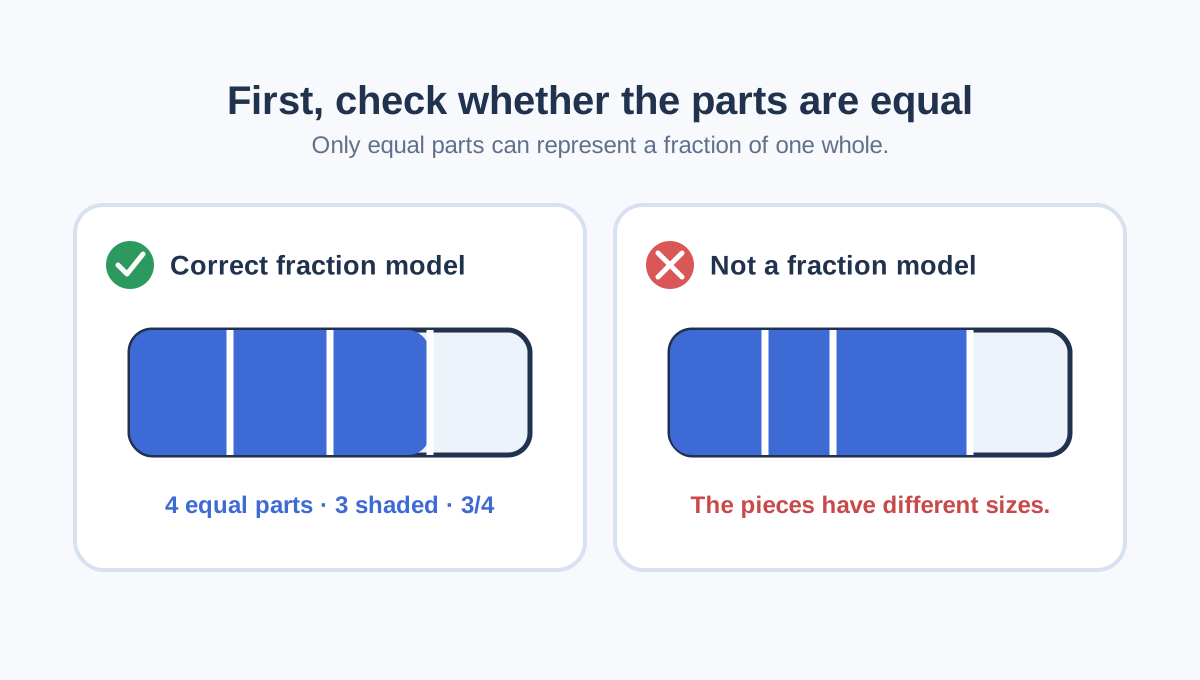
A comparison between a bar split into four equal parts and a bar split into unequal parts, showing that only equal parts make a correct fraction model.
Count pieces only after checking that they are equal parts of the same whole.

What does identifying fractions mean?

Identifying fractions means looking at a model and deciding what fraction it shows. The model might be a shaded rectangle, a circle, a group of counters, or a point on a number line. In every case, the same questions lead the way: What is the whole? How many equal parts does it have? How many of those parts are being counted?

Children sometimes begin with the colored area because it is the most noticeable part of a picture. That can cause mistakes. The denominator does not come from the colored parts; it comes from the complete whole. Slowing down long enough to name the whole makes the fraction much easier to read correctly.
Check equal parts before you count

A correct fraction model has equal parts. If a rectangle is cut into four sections but one section is much wider than the others, those sections are not fair fourths. There may be four visible pieces, but they do not represent four equal shares of one whole.

This is an important distinction because children can count accurately and still name the fraction incorrectly. Ask, “Would each person get the same amount if these pieces were shared?” If the answer is no, the picture is not a reliable fraction model. Equal parts are the idea to check before any numerator or denominator is written.

Identify fractions in shaded shapes

When a shape is divided into equal pieces, the total number of pieces becomes the denominator. The shaded or selected pieces become the numerator. A bar split into four equal parts with three shaded shows 3/4. The four tells you the whole is made from four equal shares, and the three tells you how many shares are selected.

The same reasoning works with circles, squares, and strips. A circle divided into two equal halves with one half shaded is 1/2. A rectangle divided into six equal boxes with two shaded is 2/6. A child can simplify 2/6 to 1/3 later, but it is useful to identify what the original picture shows first.

Identify fractions in a group of objects

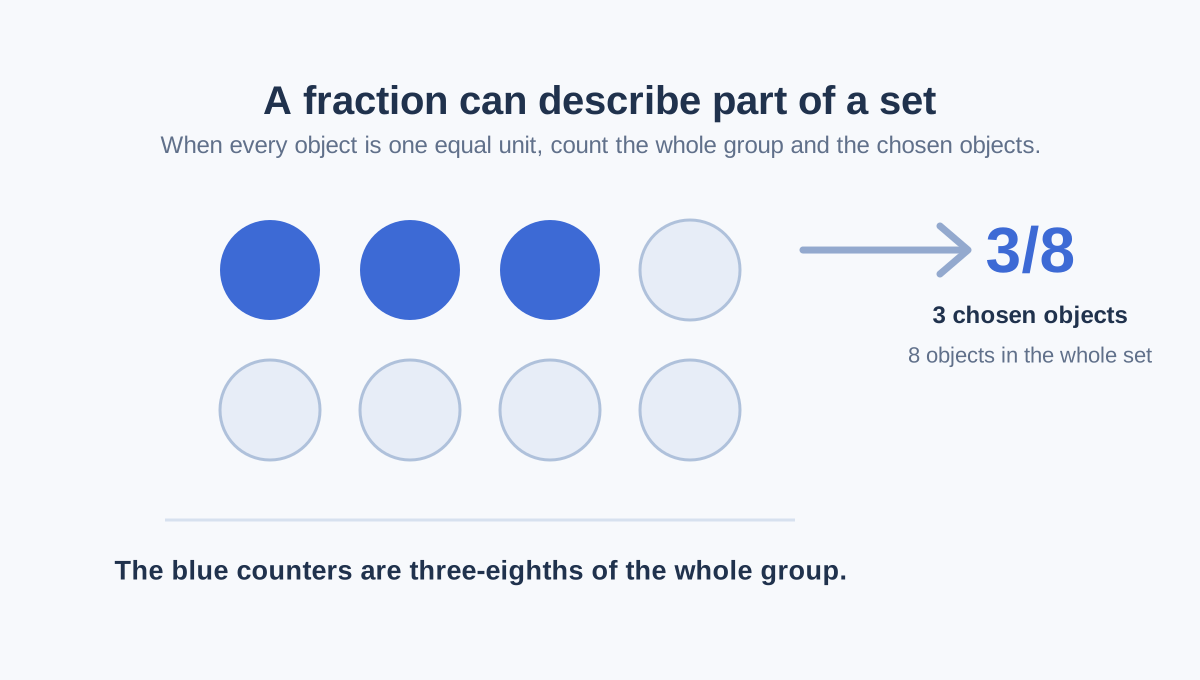
Fractions can describe a set, not only a shape. Imagine eight counters on a table and three are blue. The whole is the complete set of eight counters. Because every counter counts as one equal object, the blue counters make up 3/8 of the set.

A group model can be easier for children who struggle to see equal slices in a circle. Use objects with the same value, such as eight matching buttons or eight identical blocks. If the objects are different sizes or represent different amounts, pause and decide whether they can truly be counted as equal units before writing a fraction.

Use the same checks on a number line

A number line also shows fractions, but the whole is the distance from 0 to 1. If that distance is divided into four equal intervals, the first mark after 0 is 1/4, the second is 2/4, and the third is 3/4. The intervals must be the same length, just as parts of a bar must be the same size.

Number lines are helpful because they connect fractions to numbers rather than only to shaded pictures. A child who identifies 3/4 on a number line can see that it is less than one whole and greater than one-half. This prepares them to compare fractions later without relying only on a picture.

Notice common look-alikes and mistakes

A picture can look like a fraction model without being one. Unequal pieces, more than one whole mixed together, or an unclear group can all make a fraction question confusing. Teach children that it is okay to stop and say, “I cannot name this fraction yet because I need to know the whole or check the parts.”

Another common mistake is switching the numerator and denominator. Return to a sentence that can be checked against the picture: “There are ___ equal parts altogether, and ___ are shaded.” The first number belongs on the bottom; the second belongs on top. The model should always be able to prove the written answer.

Step by step

Use this sequence with your child

  1. 1

    Find the whole

    Circle, point to, or name the complete shape, group, or distance from 0 to 1.

  2. 2

    Check equal parts

    Make sure every part has the same size or every object counts as one equal unit.

  3. 3

    Count all parts

    Use the number of equal parts in the whole as the denominator.

  4. 4

    Count selected parts

    Use the shaded, colored, or chosen parts as the numerator, then read the fraction aloud.

Eight equal counters with three blue counters, showing that the blue counters represent three eighths of the complete group.
Fractions can describe a set: three selected counters out of eight equal counters is 3/8.

Example

A shaded bar

A bar has eight equal sections and five are shaded. It represents 5/8 because there are eight equal parts altogether and five selected parts.

Example

A set of objects

There are ten identical counters, and four are yellow. The yellow counters represent 4/10 of the complete group.

Tips for Parents

  • Before asking for a fraction, ask your child to point to the complete whole or complete set.
  • Mix correct and incorrect models together so your child practices checking for equal parts instead of only counting.
  • Use matching objects for set models. Different-sized objects can make equal shares harder to see.
  • Ask your child to say “___ equal parts altogether; ___ selected” before they write the fraction.

Common questions

Identifying Fractions FAQ

Find the whole, check that the parts are equal, count all equal parts, and then count the selected parts.