
LumaMathLumaMathParent-friendly math tools

Understanding fractions · what is half of 1 3/4

What Is Half of 1 3/4?

Half of 1 3/4 is 7/8. You can find the answer by splitting the whole number and fractional part separately, or by changing 1 3/4 into the improper fraction 7/4 and multiplying by 1/2.

Explore the main fraction lesson

Quick answer

1 3/4 = 7/4. Finding half means multiplying by 1/2, so 7/4 × 1/2 = 7/8. Therefore, half of 1 3/4 is 7/8.

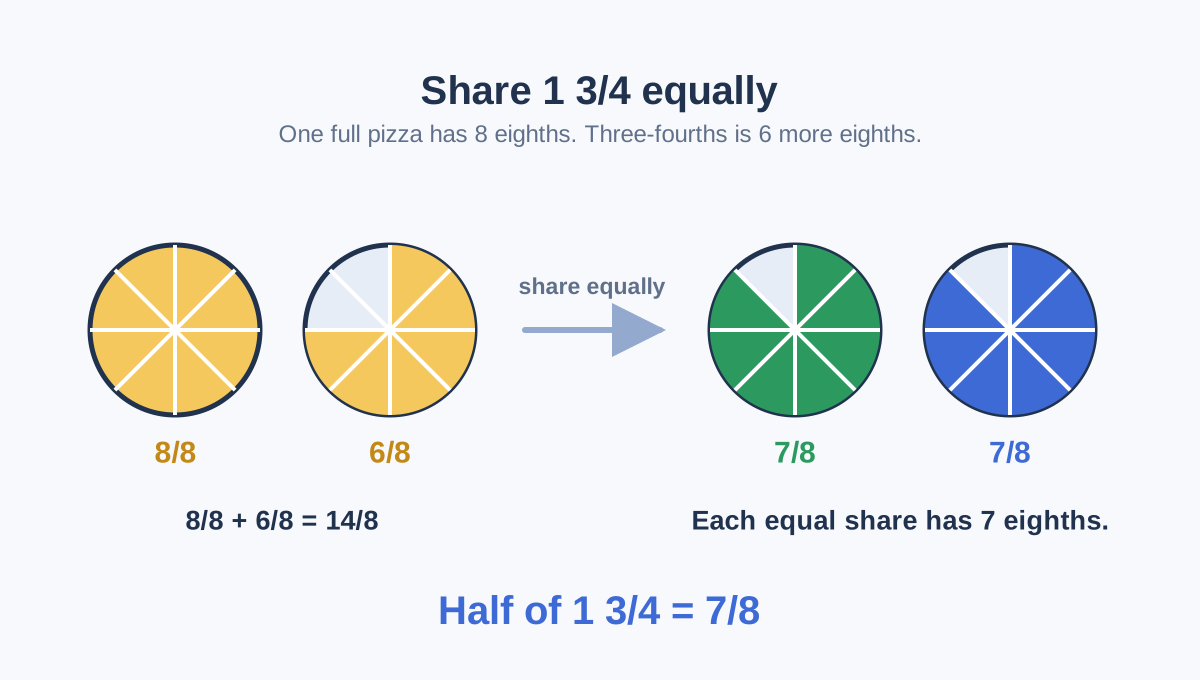
One whole pizza with eight equal slices and six eighths of a second pizza shared into two equal portions of seven eighths.
A full 8/8 pizza plus 6/8 more slices make 14/8; sharing them equally gives two portions of 7/8.

Start by estimating the answer

One and three-fourths is a little less than 2. Half of 2 is 1, so half of 1 3/4 should be a little less than 1. This estimate is useful before you calculate because it gives you a size check. An answer larger than 1 3/4 cannot be right, and an answer such as 1 3/8 is too large to be half.

The answer 7/8 fits the estimate. Seven-eighths is just below one whole, and 1 3/4 is just below two wholes. Estimation does not replace the calculation, but it helps a child decide whether the final answer makes sense.
Method 1: split the mixed number into two parts

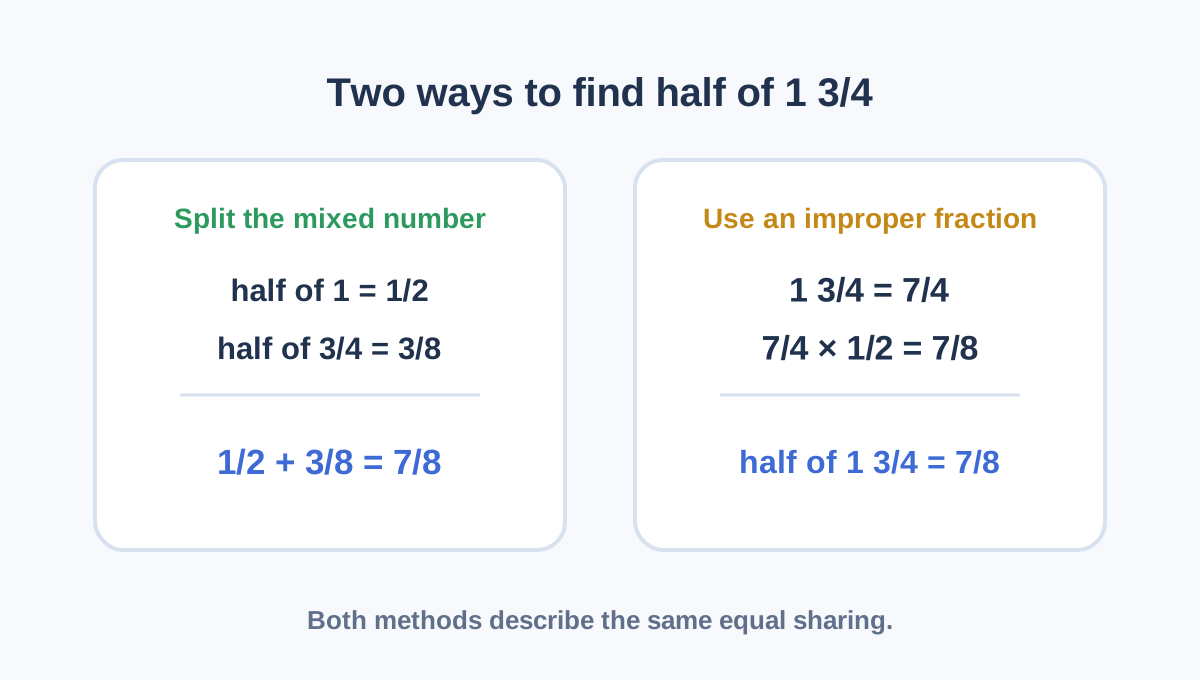
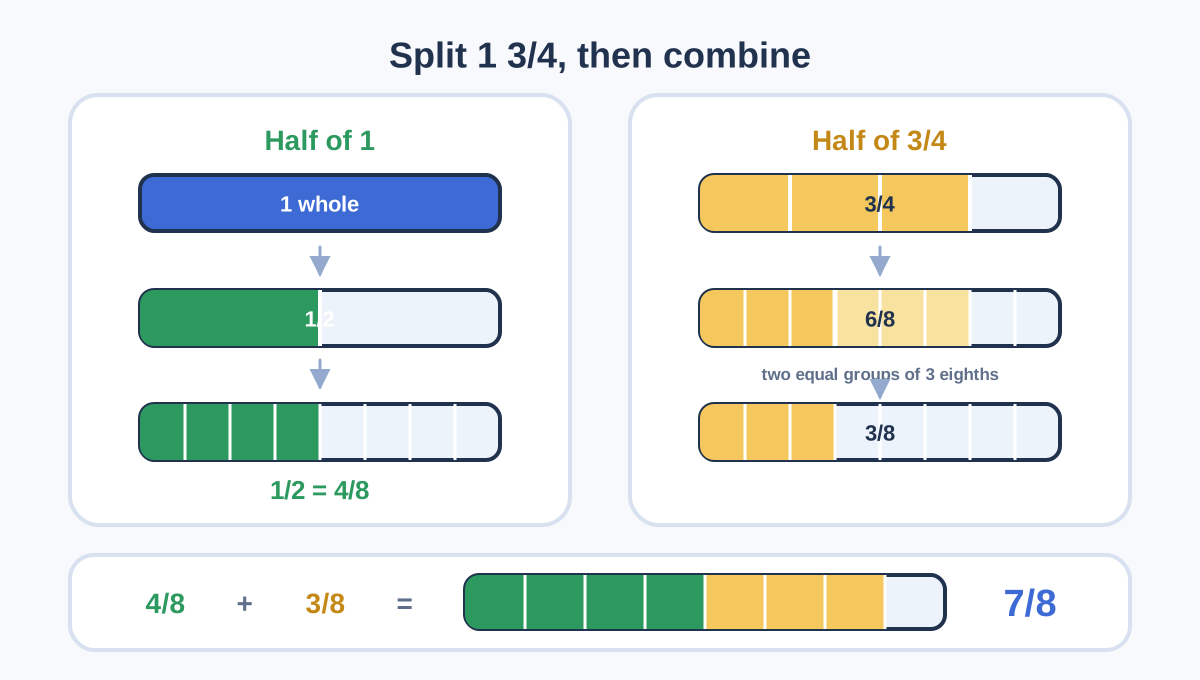
A mixed number has a whole-number part and a fractional part. In 1 3/4, the whole-number part is 1 and the fractional part is 3/4. You can find half of each part separately. Half of 1 is 1/2. Half of 3/4 is 3/8 because each fourth is cut into two equal eighths.

Now add the two halves: 1/2 + 3/8. Rewrite 1/2 as 4/8, then add 4/8 + 3/8 = 7/8. This method is especially helpful for children who can picture sharing a whole and sharing the remaining fraction at the same time.

Why half of three-fourths is three-eighths

Imagine three fourths of a bar. To take half of that amount, split each fourth into two matching pieces. Each fourth becomes two eighths. The three original fourths become six eighths, and half of those six eighths is three eighths.

Another way to say it is that halving makes every selected piece half as large. Fourths become eighths because an eighth is half of a fourth. The number of selected pieces stays three when you divide each selected fourth into two equal shares and give one share to each group.

Method 2: use an improper fraction

You can also rewrite 1 3/4 as an improper fraction. One whole is 4/4, so one whole plus three fourths is 4/4 + 3/4 = 7/4. The mixed number 1 3/4 and the improper fraction 7/4 name the same amount.

Finding half means multiplying by 1/2. Multiply 7/4 × 1/2 to get 7/8. This method is shorter once a child is comfortable changing mixed numbers into improper fractions. It also shows a general rule: taking half of any number is the same as multiplying by one-half.

See the equal sharing in eighths

The fraction 1 3/4 can be written as 14/8. One whole is 8/8, and three-fourths is 6/8, so together they make 14/8. If fourteen eighths are shared equally between two groups, each group receives seven eighths.

This visual method explains why the answer is not 7/4. The original amount has fourteen eighth-sized pieces. Half means one of two equal groups, so each group gets seven of those pieces. Seven eighths is the amount in one group.

Common mistakes to avoid

A common mistake is to divide the whole number but leave the fraction unchanged, writing 1/2 + 3/4. That is not half of the full amount because the 3/4 must also be shared into two equal parts. Both parts of the mixed number need to be halved.

Another mistake is to add one whole after finding half, such as writing 1 3/8. Use the estimate to catch this: 1 3/8 is greater than one, but half of a number less than two should be less than one. Returning to a bar model or number line can make the error easy to see.

Practice the same idea with nearby examples

Try half of 1 1/2. Rewrite it as 3/2, then multiply by 1/2 to get 3/4. Or split it: half of 1 is 1/2, half of 1/2 is 1/4, and 1/2 + 1/4 = 3/4. Both methods agree.

Next try half of 1 1/4. As an improper fraction, it is 5/4. Half of 5/4 is 5/8. These examples build the habit of checking that a half of a number between one and two must land between one-half and one whole.

Step by step

Use this sequence with your child

  1. 1

    Estimate

    Since 1 3/4 is just below 2, its half should be just below 1.

  2. 2

    Rewrite the mixed number

    Change 1 3/4 into 7/4 by writing one whole as 4/4 and adding 3/4.

  3. 3

    Take one-half

    Multiply 7/4 by 1/2 to get 7/8.

  4. 4

    Check the size

    7/8 is less than one and close to one, so it is a sensible half of 1 3/4.

Two methods for finding half of one and three fourths: splitting the mixed number and using the improper fraction seven fourths.
Both methods describe the same operation and reach the same answer, 7/8.

Example

Half of 1 1/2

1 1/2 = 3/2. Then 3/2 × 1/2 = 3/4.

Example

Half of 1 1/4

1 1/4 = 5/4. Then 5/4 × 1/2 = 5/8.

A visual model showing half of one is one half, half of three fourths is three eighths, and the two amounts combine to seven eighths.
Split the whole and fractional parts separately, then combine 1/2 and 3/8 to get 7/8.

Tips for Parents

  • Estimate first: half of an amount between one and two must be between one-half and one.
  • Use the split method before the improper-fraction method if your child still benefits from seeing the whole and fractional parts separately.
  • Ask why fourths become eighths when they are cut in half, instead of presenting the denominator change as a rule.
  • Let your child verify both methods reach 7/8. Agreement between methods builds confidence.

Common questions

What Is Half of 1 3/4? FAQ

Half of 1 3/4 is 7/8.