
LumaMathLumaMathParent-friendly math tools

Understanding fractions · 4.2 as a fraction

What Is 4.2 as a Fraction?

To write 4.2 as a fraction, use the tenths place: 4.2 = 42/10. Then simplify 42/10 to 21/5, which is also 4 1/5.

Explore the main fraction lesson

Quick answer

4.2 = 42/10 = 21/5 = 4 1/5. The digit 2 is in the tenths place, so write 4.2 as forty-two tenths and simplify the fraction by dividing both numbers by 2.

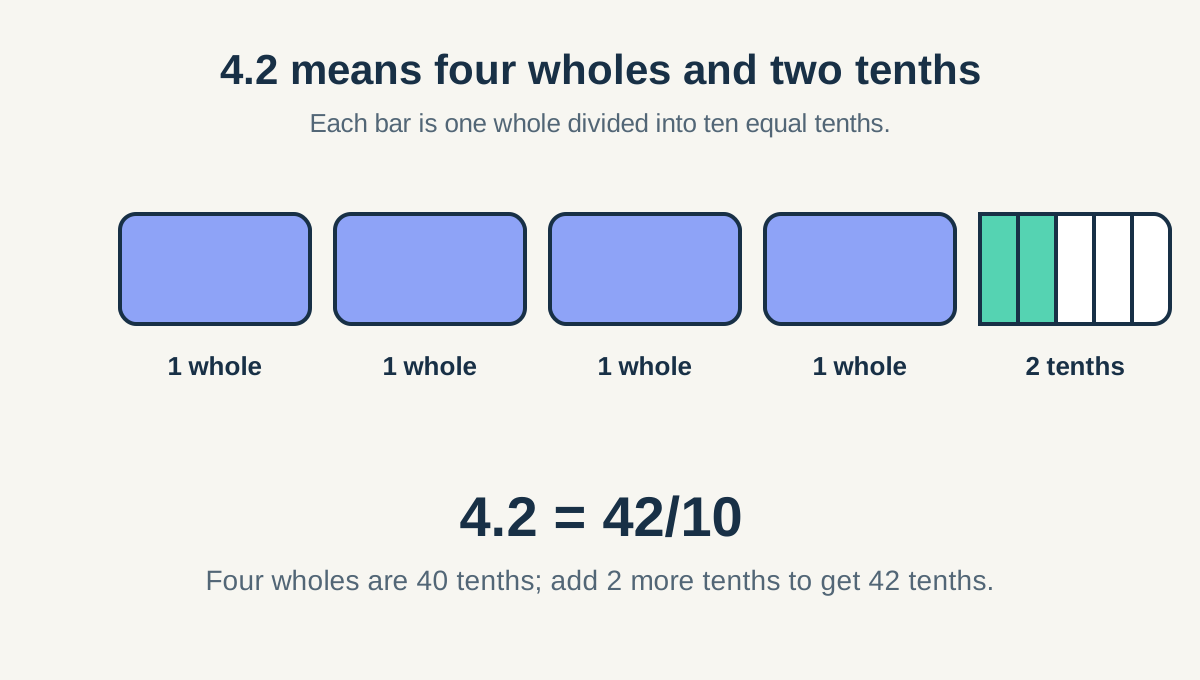
Four whole bars and two of ten equal parts in a fifth bar, showing four and two tenths.
Four wholes and two tenths make 4.2, which can be counted as 42 tenths.

Start with the place value

In 4.2, the 4 is in the ones place and the 2 is in the tenths place. The decimal has one digit after the decimal point, so the amount is measured in tenths.

Reading 4.2 as “four and two tenths” makes the fraction conversion easier to see. Four wholes are 40 tenths, and the extra 2 tenths make 42 tenths altogether.
Write 4.2 as 42/10

Because there is one decimal place, put 42 over 10: 4.2 = 42/10. The denominator 10 tells us that the numerator counts tenths.

You can also use a place-value chart. Move the decimal point one place to the right to make 42, then use 10 as the denominator because the decimal moved one place.

Simplify 42/10 to 21/5

Both 42 and 10 can be divided by 2. Divide the numerator and denominator by the same number: 42 ÷ 2 = 21 and 10 ÷ 2 = 5. So 42/10 simplifies to 21/5.

The value does not change when both parts of a fraction are divided by the same nonzero number. The simplified fraction 21/5 is easier to read and use in later calculations.

Write the answer as a mixed number

The fraction 21/5 is an improper fraction because the numerator is greater than the denominator. Five fifths make one whole, and 21 fifths contain four full groups of five with one fifth left over.

That gives the mixed number 4 1/5. The forms 4.2, 42/10, 21/5, and 4 1/5 all name exactly the same amount.

Keep trailing zeros when they show place value

A decimal such as 2.9000 can look different, but the extra zeros do not change its value. It means 29000/10000, which simplifies to 29/10 and then to 2 9/10.

Count the digits after the decimal point before you choose the denominator. One digit means tenths, two digits mean hundredths, three digits mean thousandths, and four digits mean ten-thousandths.

Step by step

Use this sequence with your child

  1. 1

    Count decimal places

    4.2 has one digit after the decimal point, so use tenths.

  2. 2

    Remove the decimal point

    Write 42 as the numerator and 10 as the denominator: 42/10.

  3. 3

    Find a common factor

    Both 42 and 10 are divisible by 2.

  4. 4

    Simplify and check

    42/10 = 21/5 = 4 1/5, which matches the original value 4.2.

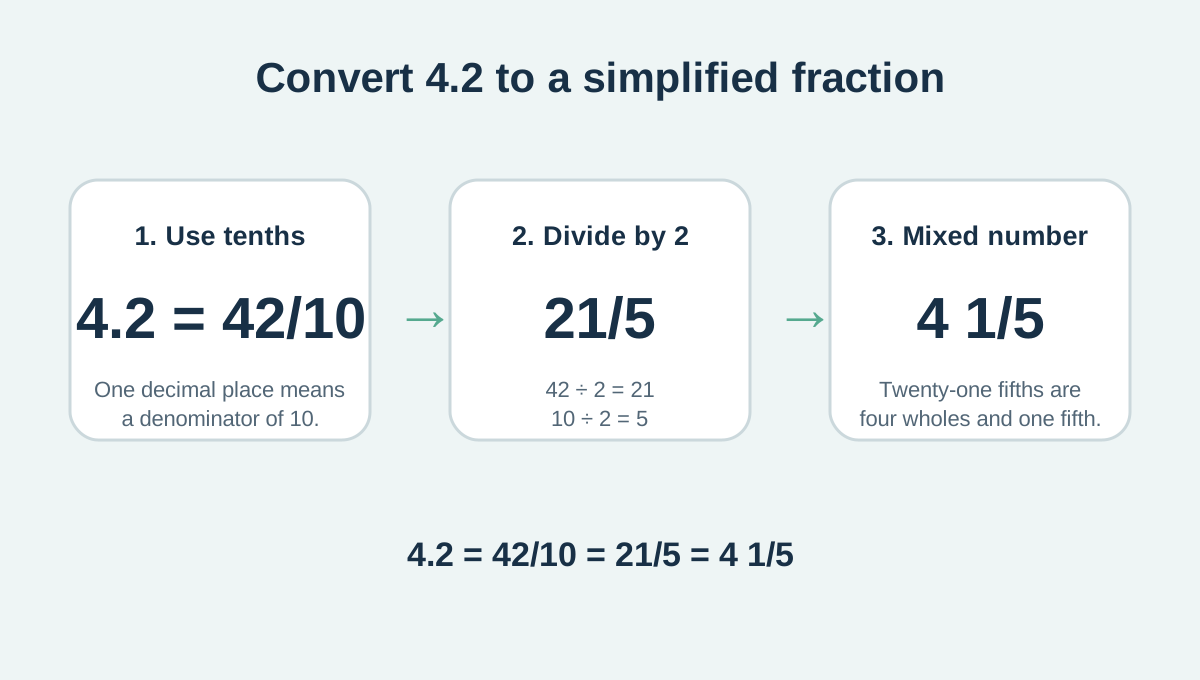
The steps four point two equals forty-two tenths, then twenty-one fifths, then four and one fifth.
Write the decimal as a fraction with denominator 10, then divide the numerator and denominator by 2.

Example

0.2 as a fraction

0.2 = 2/10 = 1/5.

Example

1.5 as a fraction

1.5 = 15/10 = 3/2 = 1 1/2.

Example

2.9000 as a fraction

2.9000 = 29000/10000 = 29/10 = 2 9/10.

Example

4.0 as a fraction

4.0 = 40/10 = 4/1 = 4.

Tips for Parents

  • Ask your child to name the place value of the last digit before choosing a denominator.
  • Use “forty-two tenths” aloud before writing 42/10, so the numerator and denominator have a visible meaning.
  • Have your child check the simplified fraction by converting 21/5 into the mixed number 4 1/5.
  • Compare 4.2 and 4.20 to show that trailing zeros change the notation, not the amount.

Common questions

What Is 4.2 as a Fraction? FAQ

4.2 = 42/10 = 21/5. As a mixed number, it is 4 1/5.